For-profit, nonprofit, and government leaders make decisions impacting our workforce and economy, our children and their education, our environment, housing and health care, and many are called upon when unexpected events happen in our state or nationally.
Minnesota is home to more than 30,000 leaders who play vital roles in the direction of our state.
Beginning in 2018, Minnesota Compass and the Bush Foundation partnered to collect data on the leadership in our state and how our institutions are developing the talent Minnesota needs. This is an update from our most recent leadership data, including secondary data from the 2020-24 American Community Survey and primary data collected through interviews with nonprofit and government leaders in 2024.
Our leaders are becoming more diverse…in some ways.
Historically, Minnesota’s for-profit, nonprofit, and government leaders have largely been White, able-bodied men. While that continues to be true, recent Census data indicates that our leadership workforce has been diversifying, with larger shares of leaders identifying as women and/or Black, Indigenous, or People of Color (BIPOC) than 15 years ago.
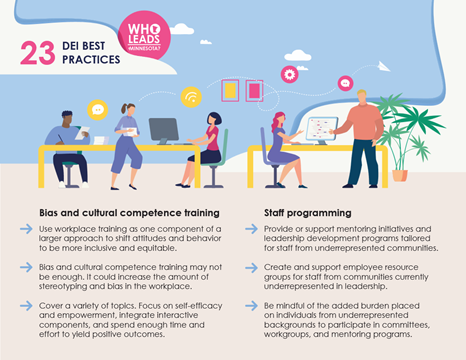
23 DEI Best Practices
What works (and what doesn't) in diversity, equity, and inclusion? Download this brochure outlining 23 best practices that can help foster more equitable and inclusive leadership.
get the pdf
In Minnesota's nonprofit sector, the path to supporting historically excluded leaders has many steps.
Through interviews, nonprofit leaders offered insight into how nonprofits can better support people who have been historically excluded from leadership roles.
- Starting with who gets in, nonprofits can build equitable pathways into leadership through transparent and fair hiring and promotion practices, equitable pay and benefits, and recognizing lived experience as a meaningful qualification.
- Once hired, to address who moves up, nonprofits can support growth and advancement through mentorship, training and coaching, and networking opportunities that are paid.
- Whether hired or promoted, who stays is also important. Nonprofits can help diverse leaders thrive by fostering an inclusive culture, providing flexible and accessible work environments, providing anti-bias and cultural sensitivity training, and ensuring work on diversity, equity, and inclusion (DEI) is shared by all.
- Sharing power is about who influences the organization. Nonprofits should take steps to ensure marginalized voices are heard and used to shape organization direction.
- Finally, equity is sustained by who is accountable. For equity to be institutionalized, nonprofits must commit to ongoing accountability and transparency in policies, processes, and decision-making, which includes aligning resources with equity goals.
As one nonprofit leader said, “We have to address the systemic racism that exists in our nonprofit cultures, and create spaces for People Of Color, women, and people with disabilities to succeed.”
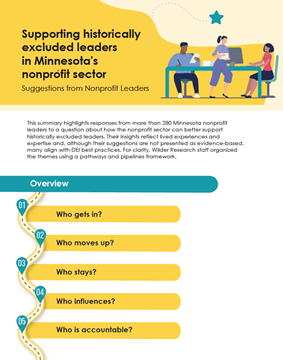
Supporting historically excluded leaders in Minnesota's nonprofit sector
How can the nonprofit sector better support historically excluded leaders? Download this roadmap of summary responses and insights from more than 280 nonprofit leaders in Minnesota.
get the pdf
Government leaders are motivated to serve and improve their communities.
Government leaders include individuals who direct operations at all levels of government, including the military. Our data show that nearly 9 of 10 government leaders are elected. In interviews, we asked what factors were key to government leaders taking on these roles. The top five factors they identified were:
- Government leaders want to give, make a difference, and improve their communities.
- Leaders have past experiences that have given them the skills and training necessary to take on government leadership or elected positions.
- Leaders are often also active members of their communities as volunteers prior to joining government.
- Some government leaders are encouraged or asked to step forward or run for office.
- Dissatisfaction or desire for change can motivate some to seek a leadership role in government.
Considering these factors and engaging community members in leadership can further diversify government leadership.
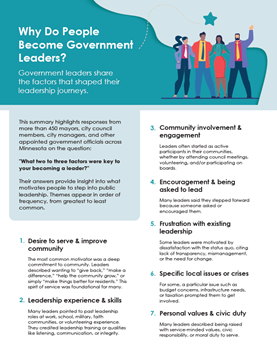
Why do people become government leaders?
Download this summary of responses from more than 450 mayors, city council members, city managers, and other appointed government officials from across Minnesota.
get the pdf
Additional calls to action
Beyond implementing some of the practices and insights shared above, here are two more ways you can learn more about trends in leadership and help foster more equitable and inclusive leadership.
Are you looking to grow your own leadership skills? Are you supporting or mentoring a colleague on their leadership journey? Find the perfect program for you or a colleague in our Leadership Development Program Directory.
- For example, the Initiators Fellowship is a program for social entrepreneurs in several regions of greater Minnesota, offering training and development, mentorship and coaching, and a stipend to support their development and investment of time.
- Also, check out Wilder’s civic engagement programming for people looking to grow their advocacy leadership skills.
Visit us at the Wilder Research table at the 2026 MCN Annual Conference on October 29-30, 2026. We’ll be there with copies of the brochures and summaries shared here. And we love to talk data!