Who leads in MN?
A project of Minnesota Compass and the Bush Foundation
For Minnesota to be its best, we need talented leaders from all backgrounds to make our institutions work well for all.

Who are Minnesota's leaders?

What did Minnesota's leaders tell us?

Minnesota's leaders at a glance
Fast facts about Minnesota's leaders
of leaders are women
The share of leaders who are women has increased over the last 15 years – from 20% in 2009 to 30% in 2024. Across sectors, women’s representation in business leadership lags behind the nonprofit and government sectors.
of leaders are BIPOC
Today, 15% of Minnesota’s leaders are Black, Indigenous, or People of Color (BIPOC), compared to 19% of all Minnesotans. This gap in representative leadership has narrowed over the past 15 years.
of leaders are age 45-64
Nearly two-thirds of Minnesotas leaders are people in their mid- to late-career age range (45-64), compared to about one-third of all Minnesota adults who are in this age range.
of leaders live in greater Minnesota
Minnesota's leaders are under-represented in greater Minnesota and over-represented in the Twin Cities. This is largely led by leadership trends in the nonprofit and business sectors.
Insights and analysis
What the data tell us about leadership issues and trends in Minnesota
An update on Minnesota’s leaders and their pathways into leadership

Supporting historically excluded leaders in Minnesota's nonprofit sector
Why do people become government leaders?
Do nonprofit leaders out-earn business and government leaders? A closer look at the data

Promising progress and persistent gaps: Census data and leadership diversity

Navigating the DEI landscape: Insights from HR professionals

How did leaders come into their leadership positions?

What shapes a leader? A look at culture and demographics

Informal ways to gain leadership experience

How are Minnesota organizations supporting leaders of all backgrounds?

Understanding leadership within Minnesota

Who leads in Minnesota?

Resources for leadership development
Learn about best practices for fostering diverse and inclusive leadership. Dig into our searchable directories for leadership programs and training providers.
Leadership program directory

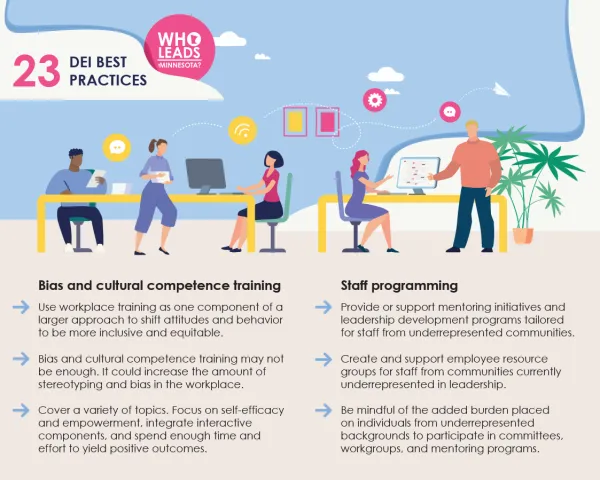
23 DEI best practices
Racial equity resource directory

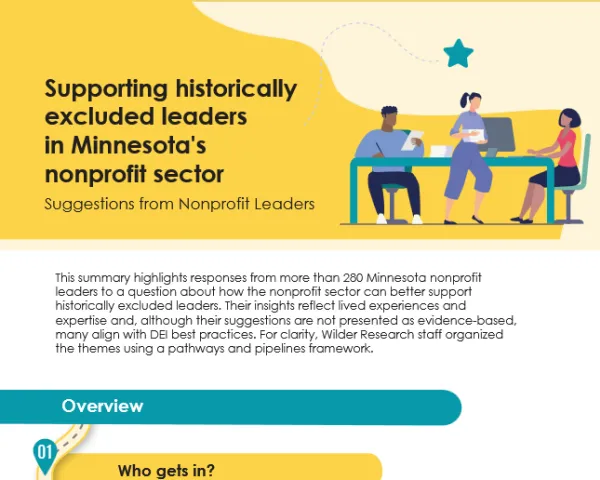
Supporting historically excluded leaders in Minnesota's nonprofit sector
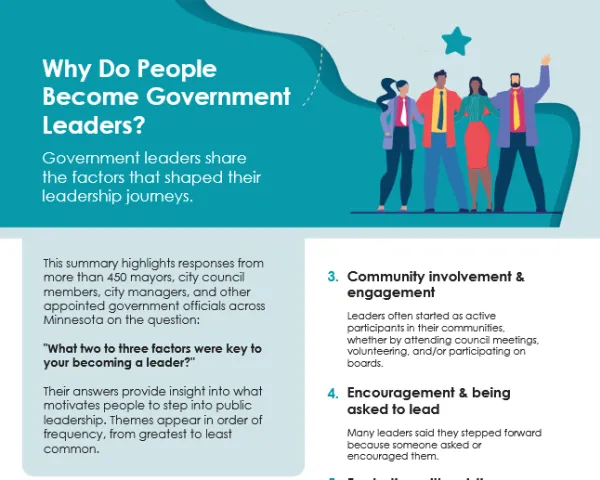
Why do people become government leaders?
Minnesota Compass and the Bush Foundation teamed up to provide a holistic picture of institutional leadership in our state and how our institutions are developing the talent Minnesota needs.
Demographic data on who holds leadership positions in business, government, and nonprofits in Minnesota have not been readily available or easily accessible, nor has information about what is helping foster more equitable and inclusive leadership.
Understand who leads:
We will research Minnesota’s leaders in the business, government and nonprofit sectors.
share promising practices:
We will uncover how sectors develop the talent Minnesota needs.
spark change:
We aim to inspire employers to foster more equitable and inclusive leadership.
Measure progress:
We will track leadership data on a regular basis.
Minnesota Compass analysis uses data from the Integrated Public Use Microdata Series (IPUMS-USA), which collects and harmonizes U.S. Census Bureau American Community Survey (ACS) data. The ACS includes demographic characteristics (age, race, nativity) and workforce information (occupation, employment status, wages, sector). Estimates are based on five-year data collection periods.
Leadership definition: Leaders are defined as currently employed individuals whose primary occupations are classified by the Census Bureau as "Chief executives and legislators." Occupation data comes from self-reported, open-ended responses to "What was this person's main occupation?" which are then recoded by the Census Bureau into standard occupation categories.
Sector classification: Leadership data is categorized into three sectors based on self-reported employment type. Government sector includes local, state, federal civilian, and military employees. Nonprofit sector includes tax-exempt and charitable organizations. For-profit sector combines both private company employees and self-employed workers (incorporated and non-incorporated business owners, professional practices, and farms).
Data limitations: Some high-level leaders may describe their occupation in ways that don't get coded into the "Chief executives and legislators" category. All occupation and sector classifications rely on self-reported survey responses from ACS participants. The number of leaders by sector may not match organizational counts from other sources like the Quarterly Census of Employment and Wages (QCEW) because ACS provides sample-based estimates while QCEW provides census counts, and because large organizations may have multiple leaders while smaller organizations may have leaders who don't identify as "executives.”
Citation: Steven Ruggles, Sarah Flood, Matthew Sobek, Daniel Backman, Grace Cooper, Julia A. Rivera Drew, Stephanie Richards, Renae Rodgers, Jonathan Schroeder, and Kari C.W. Williams. IPUMS USA: Version 16.0 [dataset]. Minneapolis, MN: IPUMS, 2025. https://doi.org/10.18128/D010.V16.0
Technical note: Complete occupation codes are available at https://usa.ipums.org/usa/volii/occ2018.shtml
Wilder Research and Bush Foundation partnered with the Minnesota Chamber of Commerce to survey business leaders and partnered with the League of Minnesota Cities to survey government leaders.
The survey of business leaders was open from November 21, 2024 - January 31, 2025. Of the 11,000 business leaders invited to complete the survey, 34 responded, for a response rate of 0.3%.
The survey of government leaders was open from September 18 - November 5, 2024. Of the 3,368 government leaders invited to complete the survey, 599 responded, for a response rate of 18%.
Wilder Research and Bush Foundation partnered with the Minnesota Council of Nonprofits to survey leaders. Chief executive officers (CEOs) and executive directors (EDs) were invited to participate in a demographic survey to supplement estimates of people serving as nonprofit leaders across Minnesota.
The survey of nonprofit leaders was open from November 14 - December 16, 2024. Of the 8,138 nonprofit leaders invited to complete the survey, 284 responded, for a response rate of 3.5%.
The nonprofit sector included respondents who identify as nonbinary, women, men, and individuals who opted to self-describe their gender identity. The government sector included respondents who identify as transgender, nonbinary, women, men, and individuals who opted to self-describe their gender identity. The business sector only included respondents who identify as women and men.
Inquiries and media requests
Allison Liuzzi
Compass Project Director
651-280-2724
allison.liuzzi@wilder.org