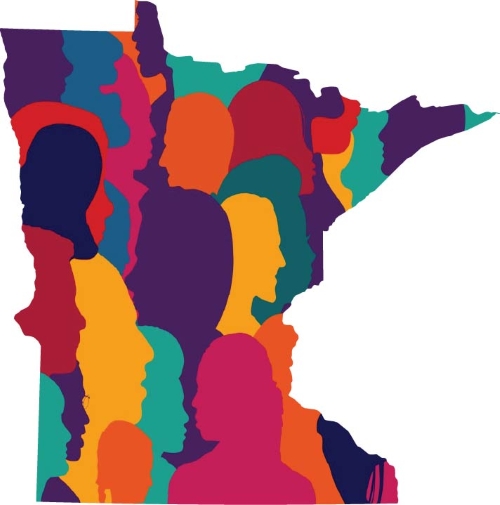
Image of the state of Minnesota with multiple brightly colored faces within the shape

It is impossible to send out our regular newsletter without acknowledging the traumatic events of recent weeks. We’ve witnessed how this large federal immigration enforcement operation has ruptured Minnesota with fear, grief, and tension. We’ve also seen Minnesotans rise up to support our neighbors in so many inspiring ways.

If our Minnesota Compass project has been quiet in recent weeks, it is not because of a business-as-usual mindset. It is because we walk a fine line between commitment to making sure reliable facts are available to communities that need them, and caution against allowing data to be weaponized against those same communities. Every data point represents real people, who could be made more vulnerable by a misleading headline or unintentionally heightened visibility. 

But we also know that good data are essential for countering misinformation and allowing decision makers to make informed choices in fraught circumstances. As we navigate those tensions, Minnesota Compass remains committed to keeping our data accessible, updated, and reliable, and to keeping an eye on state and national trends as the ground shifts rapidly underneath us.

Minnesota Compass is, first and foremost, a quality-of-life project. Even though we don’t have real-time data to reflect Minnesotans’ lived experiences at this moment, here is what we know to be true:


  1. Minnesotans help each other.

    Our state is home to high levels of civic engagement, ranking first (or close to it) across measures of social connection and community building. We tend to think of civic engagement in terms of voter turnout and yes, Minnesota has consistently high voter turnout. But our state’s social fabric has been woven by other important forms of engagement as well.

    Two-thirds of Minnesotans have helped or been helped by their neighbors in the previous year. This data source doesn’t give us additional information on how Minnesotans are helping their neighbors, but you don’t need to look far to see Minnesotans who are – probably right now – shoveling snow, delivering groceries, watching kids, and checking in on people who live nearby.

    We also put those efforts into formal volunteering. More than 40% of Minnesota adults volunteer throughout the year, with large shares of Minnesota’s volunteers engaging in fundraising and/or collecting and distributing food. Our community institutions are the backbone of this work: religious organizations, schools, and social and community organizations coordinate many of these volunteer efforts. 

  2. We are all Minnesotans.

    Minnesota is home to 5.8 million residents, sitting somewhere in the middle of all states for population size and “somewhere in the middle of the country” for folks unfamiliar with our state. We are occasionally thrust into the national spotlight and, in those times, we can be uncharacteristically vocal about our pride in our state. But our Minnesotan-ness would have most of us just as soon fly under the radar and get back to doing Minnesota things, like determining when it's warm enough to wash the salt off our cars, or making sure you know Prince was from Minnesota.

    All of our 5.8 million residents are Minnesotans, and we are a diverse state. Indigenous communities have always lived here and, today, 11 sovereign Tribal Nations share geography with Minnesota. More than 160,000 Minnesotans identify as Native American, alone or in combination with another race or ethnicity.

    Minnesota is also home to approximately 267,000 African American residents, many of whom are descendants of West and West Central Africans involuntarily brought to the United States by European and American colonial powers through the transatlantic slave trade, as well as families who later migrated to Minnesota from other regions of the country.

    Our state is also a constellation of immigrant communities, from long-established Germans and Scandinavians to recently arrived Karen, Ecuadorian, and Ukrainian communities. Today, more than 500,000 Minnesotans are foreign-born. Immigration drives population growth, especially in our rural towns, but data released this week show that growth is slowing (at best) or drying up.

    One thing has always been true in our work on Minnesota Compass— we are all Minnesotans. Our work sheds light on the unique experiences of diverse communities, but our stories are about Minnesotans: Somali Minnesotans, older Minnesotans, rural Minnesotans, Minnesotans with a disability, Minnesota families. Our narratives have never been about “us” versus “them,” but rather about one state composed of many people working to build a better future together.

 At Minnesota Compass, our mission remains the same: to provide a nonpartisan source of data and facts about quality of life in Minnesota. Our research is rigorous and transparent, while also guided by compassion, intellectual curiosity, and a commitment to human and community well-being. We believe that high-quality data empower leaders to make better, more informed decisions and that Minnesota is strongest when research insights are used to expand opportunity and improve outcomes for all Minnesotans.