Each year as we prepare the Compass Points dashboard, our team looks at each key measure to determine whether it is trending better, worse, or the same.
This year, we kept coming up against a thorny question: If things are worse compared to before the pandemic, but the same over the past five years, at what point do we say, “Unfortunately, this seems like our new normal”? Or, to flip the question the other way: When is “about the same” not good enough?
Minnesotans remain educated and engaged.
Across some domains – public safety, workforce, and civic engagement – we are seeing improvement or continuing success. And sometimes, holding steady is actually a good thing.

Public safety
- Serious crime is at an historic low, a measurable improvement in public safety that is also reflected in Minnesotans’ feelings of safety in their community and at school.
- Our cars and roads are the safest they have ever been.

Workforce
- Our state continues to have high levels of educational attainment and postsecondary degree completion.
- Minnesota is home to one of the highest shares of adults working in the country, an area where we may be close to maxing out labor force participation. In other words, a flat line is not a bad sign.

Minnesota’s economy is strong, but families aren’t feeling the effects.
But across other domains, things are just not getting better fast enough and may even be plateauing into a "new normal." Our economy may be settling into a new normal where economic growth is disconnected from families’ and individuals’ well-being. If Minnesota sees continued growth in economic activity and jobs, but can’t move people out of poverty or maintain the economic security of our families, we have to question what economic strength really looks like.


Family well-being
- But our poverty rate has stagnated. And median household income, once adjusted for inflation, has fallen. This decline is specific to our state and a few others; national median income has risen.

Housing affordability
- More than a quarter of Minnesotan households pay too much for housing. That share has held steady for a decade, but its persistence indicates an affordability challenge for Minnesota families.
Early childhood and educational indicators are plateauing at best.
Education is a big area where we are seeing a plateau far below where we would hope to be. We know that the pandemic caused major disruptions to our education system, and even five years later we have not fully recovered those losses.

Early childhood
- Well before formal education begins, the share of babies born at low birth weight continues to rise, making what we hoped might be a pandemic blip appear to be a longer-term negative trend.
- The share of Kindergarteners receiving early childhood screening by age 5 has been increasing, but remains lower than before the pandemic.

K-12 education
- Both 3rd grade reading scores and 8th grade math scores plunged during the pandemic, and have seen little or no recovery.

High school graduation
- High school graduation rates have risen over the past decade, but show signs of plateauing.
Health measures hold steady, for now.
Health indicators are a similar story of staying flat rather than improving. In addition to the pandemic, federal policy changes and an aging population may add additional strain to our health care systems, impacting our state’s health.

General health
- Self-reported general health (a new indicator this year) is one of the few indicators where Minnesota saw brief improvement during the pandemic. But the share of adults who say they are in good, very good, or excellent health has since fallen to its lowest point in over a decade.

Mental health
- The share of Minnesotans experiencing frequent mental distress (another new indicator this year) is also staying flat at a level higher than we saw before the pandemic.

Health insurance
- Health insurance coverage improved greatly upon the implementation of the Affordable Care Act in 2014. But coverage rates have since stagnated and may even be showing signs of getting worse. This is an indicator we are watching closely as the impacts of Medicaid cuts and expired health care subsidies take effect this year.
Minnesota’s landscape is changing rapidly.
Based on data available when this article was published, we are seeing an overall story of Minnesota’s quality of life plateauing, often at levels below what we would hope to see. But Minnesota’s landscape is also changing rapidly.
We always caution our users that each new Compass Points dashboard reflects a point in time, at least one and often two years old by the time data are released. That remains an extra important caution today – in 2026 – given that we expect to see major changes over the next few years as repercussions from federal policy actions in 2025 and 2026 ripple through our economy and institutions. As always, our Minnesota Compass team will continue to monitor and report on those changes as we wait to see whether we have reached a new normal – or another inflection point.
2026 Compass Points is out!
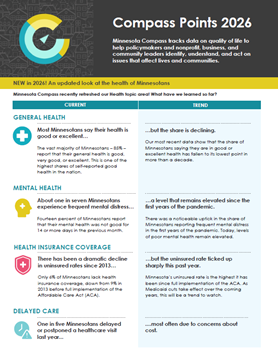
Our annual dashboard provides you with a snapshot of quality of life in our state across a range of topics.
get the pdf
Where do we go from here?
Our social fabric is strong. Minnesotans know this from recent and more distant history. Disruptions from the pandemic and, more recently, federal immigration enforcement operations show that Minnesotans come together when it matters. We are capable of remarkable recovery, and continued investments in community will be required to reverse our losses.
Compass is part of a collaborative community of researchers and policy analysts using data to tell our shared stories and inform decision-making for the well-being of all Minnesotans. Here is a curated list of trustworthy partner organizations and regional initiatives doing complementary work. Please visit their websites to learn more about how they are inspiring community-driven change, establishing regional ambitions, and adopting policy platforms.
Center for Rural Policy and Development
A non-partisan, not-for-profit policy research organization providing unbiased information and evaluation of issues from a rural perspective.
Center for Urban & Regional Affairs (CURA)
A university-based center for community-engaged research that connects talented residents, community organizations, government agencies, and researchers to develop new knowledge about public policy issues.
Minnesota Budget Project
A nonpartisan research and advocacy organization that works on policy solutions that expand opportunity and economic well-being to all Minnesotans. It is an initiative of the Minnesota Council of Nonprofits.
East Metro Pulse
Multi-year surveys, reports, and interactive data books that provide valuable insights on the region's health and vitality to help nonprofit partners, community leaders, policymakers, and others better understand the state of the East Metro.
GREATER MSP
A cross-sector partnership building the next economy for the Minneapolis–Saint Paul region—aligning leaders to accelerate growth, attract investment, and solve global challenges.
The State of ALICE in Minnesota
Research quantifying and describing the number of working families that are struggling financially, unable to afford the basics of housing, child care, food, transportation, health care, and technology.